
A recent study conducted within the GreenQUEST project has demonstrated that sparse layers of 10-nanometer silver nanoparticles significantly improve the electrochemical reduction of carbon dioxide (CO₂) into carbon monoxide (CO). This transformation is a critical step in developing technologies that convert waste carbon emissions into valuable chemical feedstocks, such as fuels and industrial precursors.
What Happened in the Study
Researchers led by Prashanth Menezes at the Helmholtz-Zentrum Berlin (HZB) systematically evaluated catalyst layers composed of silver nanoparticles. The team varied both the size and density of the nanoparticles to determine how these parameters influence the efficiency of CO₂-to-CO conversion during electrolysis. Their experiments revealed that a sparse layer—where particles are spaced apart rather than densely packed—outperformed denser configurations in producing CO at a higher rate and with greater selectivity.
The key finding was that the optimal performance emerged not from high particle density, but from a carefully controlled, low-density arrangement. This suggests that the electrochemical environment benefits from reduced particle aggregation and improved ion transport, which are essential for efficient catalytic reactions.
Key Facts from the Research
- The silver nanoparticles used in the study were precisely sized at 10 nanometers, a scale where surface-to-volume ratios are high and catalytic activity is maximized.
- The catalyst layers were applied in a sparse configuration, meaning particles were spaced apart rather than packed tightly.
- Electrolysis was used to drive the reaction: CO₂ was reduced to CO under controlled electrochemical conditions.
- The process occurs at ambient temperature and pressure, making it scalable and energy-efficient compared to high-temperature industrial methods.
- Performance metrics showed increased current efficiency and reduced overpotential, indicating a more effective and less energy-intensive reaction pathway.
Background: How the Process Works
Electrochemical reduction of CO₂ to CO is a well-studied process in the field of carbon utilization. In this reaction, carbon dioxide molecules are converted into carbon monoxide using electrical energy, typically in an aqueous solution. The reaction is governed by the following half-equation:
CO₂ + 2H⁺ + 2e⁻ → CO + H₂O
For this to happen efficiently, a catalyst is required to lower the activation energy of the reaction. Silver nanoparticles have long been recognized for their catalytic properties in such reactions due to their surface reactivity and stability under electrochemical conditions.
However, previous studies often focused on dense nanoparticle layers, which can lead to particle aggregation, poor mass transport, and inefficient electron transfer. This research introduces a novel design principle: that sparsity in nanoparticle distribution enhances performance by reducing surface blocking and enabling better access of reactants to active sites.
By using a sparse layer, the researchers achieved a more uniform distribution of active sites, allowing CO₂ molecules to reach the catalyst surface more effectively. This design also minimizes the formation of passivating layers that can inhibit further reactions.
Why It Matters
As global emissions of CO₂ continue to rise, technologies that convert this greenhouse gas into useful products are gaining importance. The ability to produce CO from CO₂ offers a pathway to close carbon loops in industrial processes—turning waste into raw materials.
CO is a versatile chemical intermediate used in the production of methanol, synthetic fuels, and other industrial chemicals. If scalable, such electrochemical systems could support circular economies by enabling carbon recycling without relying on fossil feedstocks.
Moreover, this study provides a design principle that can be applied to other catalytic systems. The insight that low-density, well-spaced nanostructures outperform dense ones may extend beyond silver and CO₂ reduction to other reactions involving gas-phase or liquid-phase conversion.
For energy technology and environmental applications, this work represents a practical advancement in catalyst engineering. It supports the broader goal of developing low-energy, scalable solutions for carbon management.

In this view of the north-east end of the wind farm, from Sandy Point, several turbines are in place although not yet commissioned, and several other bases are in situ but have yet to receive their blades.
The grid square co-ordinate is taken from a page on the Government's OPSI website
https://www.opsi.gov.uk/si/si2008/uksi_20083046_en_1 although the original 2004 consent listed 30 turbines in locations in 15 different kilometre squares from TM2007 to TM2410. by Nigel Cox, CC BY-SA 2.0, via Wikimedia Commons. · Source · License
Limitations and Open Questions
While the results are promising, several limitations remain. The current study was conducted under controlled laboratory conditions and has not yet been tested at industrial scale or under variable environmental conditions such as fluctuating temperatures or impurities in feed gas.
Additionally, the long-term stability of the silver nanoparticle layers under continuous operation is unknown. Silver can oxidize or degrade over time, especially in humid or high-temperature environments, which may affect performance in real-world applications.
Another open question is the scalability of the fabrication process. While the sparse layer design is effective, producing uniform, reproducible nanoparticle layers over large surface areas remains a challenge. Current methods may require precise control over deposition techniques, which could limit commercial adoption.
Finally, the study did not explore the economic viability of the process. The cost of silver, even at the nanoscale, may make this approach less competitive compared to other catalysts such as copper or iron-based materials.
What to Watch Next
Future research should focus on integrating these sparse nanoparticle layers into continuous-flow electrolysis systems and testing their performance under realistic industrial conditions. Long-term stability studies and durability testing under operational stress will be essential.
Additionally, researchers may explore combining silver with other materials to create hybrid catalysts that maintain high activity while reducing silver content. This could improve cost-efficiency and sustainability.
As carbon utilization technologies evolve, this work may inspire similar designs in other electrochemical systems, such as water splitting or nitrogen fixation. The principles of sparse, high-surface-area catalysts could become a standard in materials design for energy-related reactions.
For readers interested in the broader implications of carbon conversion, a 2-billion-year-old Earth clue may be misread offers insight into how ancient geological records inform our understanding of carbon cycling. Meanwhile, the future of latent space in AI highlights how machine learning could one day assist in designing better catalysts through predictive modeling.
For a deeper dive into materials science and catalysis, Recraft V4 demonstrates how AI-driven design tools are emerging to support material innovation.
Original research source: Sparse layers of 10-nanometer silver particles boost CO production from CO₂.
Sources & further reading
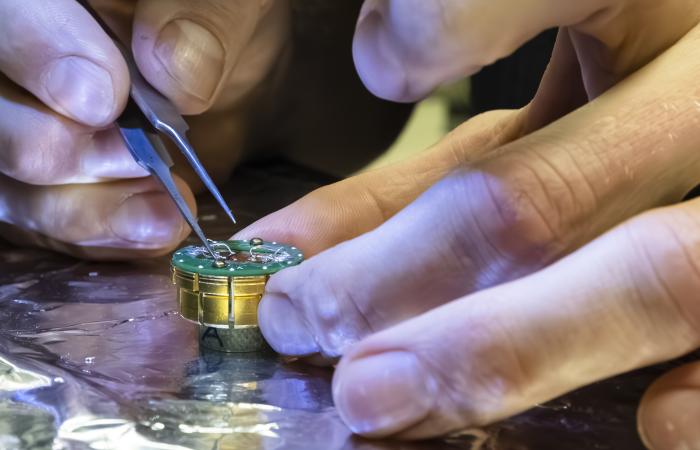
Featured image: Connecting wires to the interface of the topological insulator and superconductor enables probing of novel electronic properties. Researchers aim for qubits based on theorized Majorana particles. Credit: Carlos Jones/ORNL, U.S. Dept. of Energy
www.ornl.gov/news/researchers-advance-topological-superco… by Oak Ridge National Laboratory, CC BY 2.0, via Wikimedia Commons. Image source · License