OpenAI has launched an independent Advisory Group on Mathematics and Artificial Intelligence to support the review and communication of emerging AI results in mathematical research. The group was formed to ensure that advancements in AI applications to mathematics are transparent, scientifically sound, and responsibly shared with the broader academic community.
What Happened
According to a public announcement from OpenAI, the organization has partnered with an independent advisory group to evaluate the implications of AI systems applied to mathematical discovery and proof generation. The group’s primary role is to assess the validity, reproducibility, and interpretability of AI-generated mathematical results. This includes reviewing whether AI outputs can be considered legitimate mathematical contributions or if they require human oversight to validate.
Key Facts
- The advisory group is independent of OpenAI’s internal research teams, ensuring objectivity in its evaluations.
- Its mandate includes reviewing both the technical outputs and the communication strategies used to present AI-generated mathematical results.
- Members include leading mathematicians and AI researchers with established credentials in both fields.
- The group operates under a transparent governance model, with regular public updates and open access to its review processes and findings.
- Its work is intended to serve as a benchmark for the scientific community, helping to define standards for what constitutes valid mathematical discovery when AI is involved.
- The advisory group will evaluate not only the final outputs of AI systems but also the methodologies used to generate them—such as training data, model architectures, and algorithmic choices.
- It will also assess how AI-generated results are presented in academic publications, conferences, and open-source repositories, ensuring that claims are backed by sufficient evidence and context.
- One of the group’s core responsibilities is to identify potential biases or limitations in AI-generated mathematical reasoning, such as overfitting to training data or producing plausible but incorrect proofs.
- Members are expected to engage with the broader scientific community through workshops, peer-reviewed reports, and collaborative research initiatives to promote best practices in AI-assisted mathematics.
- The group will also consider ethical dimensions, such as the attribution of authorship in AI-generated proofs and the potential for AI to displace human mathematicians in certain domains.
Background: The Intersection of AI and Mathematics
Mathematics has long been considered one of the most rigorous and human-centered disciplines, relying on logical deduction, proof, and peer review. The integration of artificial intelligence into mathematical research represents a significant shift. AI systems can now analyze vast datasets of mathematical theorems, identify patterns, and even generate conjectures or proofs—some of which have been validated by human mathematicians.
For example, AI has been used to assist in the discovery of new mathematical structures, such as in number theory and combinatorics. Systems like AlphaGeometry, developed by DeepMind, have demonstrated the ability to generate geometric proofs that match or exceed human-level performance in certain domains. Similarly, AI models have been applied to automate parts of mathematical proofs, reducing the time required for verification and enabling exploration of complex problems that would otherwise be intractable.
However, these advancements raise fundamental questions about the nature of mathematical discovery. Is a proof generated by an AI truly a ‘discovery’ in the human sense? Does it possess the same intellectual depth or creative insight as one crafted by a human mind? These questions are not merely philosophical—they have practical implications for how mathematical knowledge is validated, shared, and credited.
Challenges and Limitations
Despite the promise of AI in mathematics, several challenges remain. First, AI systems often operate as black boxes—while they can produce outputs, understanding the internal reasoning process is difficult. This lack of transparency makes it hard to verify the validity of a proof or to identify where errors may have occurred.
Second, training data for AI models in mathematics is often limited or biased. If the data used to train these systems is drawn from a narrow set of historical mathematical results, the AI may reproduce patterns without understanding their deeper significance or generalizability.
Third, there is currently no universally accepted standard for evaluating AI-generated mathematical content. Unlike traditional scientific research, which relies on peer-reviewed journals and reproducible experiments, AI-generated results may not follow the same validation protocols. This creates a risk of misinformation or the propagation of false claims.
Implications for the Scientific Community
The formation of this advisory group signals a growing recognition that AI must be integrated into scientific research with care and oversight. By establishing an independent body to review AI-generated results, OpenAI is acknowledging that the role of AI in mathematics is not just technical—it is also epistemological and ethical.
As AI becomes more capable of generating mathematical content, the scientific community must develop new frameworks for evaluating such outputs. This includes defining what constitutes a valid proof, how to attribute authorship, and how to ensure that AI tools do not undermine the integrity of the mathematical process.
Moreover, the group’s work may influence how AI is used in other scientific disciplines—such as physics, biology, or computer science—where AI is increasingly being applied to hypothesis generation and data analysis.
Future Directions and Open Questions
While the advisory group is a significant step forward, many questions remain. For instance, how should AI-generated results be cited in academic literature? Should they be treated as a form of collaborative work between humans and machines? What happens when an AI generates a proof that is later proven incorrect—does the system bear responsibility?
Additionally, there is a need for interdisciplinary collaboration between computer scientists, mathematicians, and ethicists to develop guidelines that balance innovation with accountability. The advisory group’s findings may eventually inform policy recommendations for AI use in research institutions and funding bodies.
As AI continues to evolve, its role in mathematics will likely expand. But with this expansion comes a responsibility to ensure that the pursuit of knowledge remains grounded in human judgment, transparency, and scientific integrity.
Related reading
- Cooley’s GO Public Uses AI to Streamline IPO Process
- OpenAI Launches Australian Youth Safety Blueprint for AI
Sources & further reading
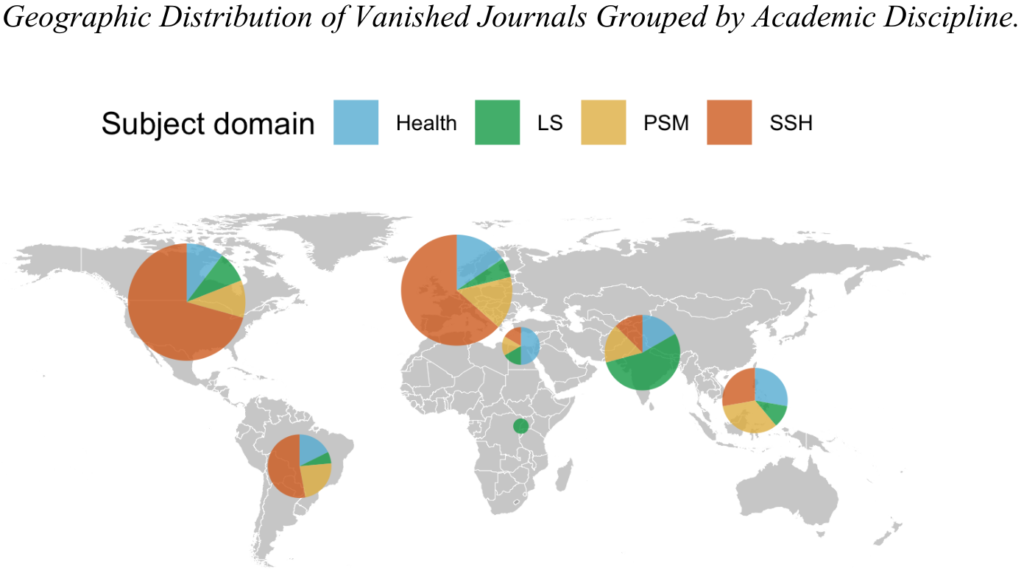
Featured image: From left to right (n=total number of vanished journals): North America (n=58), Latin America & Caribbean (n=17), Europe & Central Asia (n=52), Middle East & North Africa (n=6),Sub Saharan Africa (n=1), South Asia (n=24), East Asia & Pacific (n=18). From the study "Open is not forever: a study of vanished open access journals" by Authors of the study: Mikael Laakso, Lisa Matthias, Najko Jahn, CC BY-SA 4.0, via Wikimedia Commons. Image source · License
Leave a Reply