
Behind the glamour of New York Fashion Week lies a complex web of logistics, vendor coordination, and administrative work. For independent fashion designers, the reality is that designing clothes is only a fraction of their daily tasks. Much of their time is spent managing supply chains, adjusting set designs, and reworking visuals—processes that often require costly revisions and lengthy iterations.
What Happened: A Real-World Collaboration
Ahead of New York Fashion Week in 2026, Google’s Envisioning Studio, supported by Google Labs, collaborated directly with two independent designers—Jane Wade and Sergio Hudson—to co-develop custom tools using Google Flow, an AI-powered creative studio. These tools were designed not to replace design, but to support it by reducing friction in key production stages.
For Jane Wade, the focus was on styling. Her Google Flow tool, called the Styling Suite, allowed her to virtually curate head-to-toe looks for runway models using digital avatars. Instead of relying on in-person fittings—which can take up to three full days—she could experiment with hair, makeup, accessories, shoes, and garments in a virtual environment. This enabled her to identify missing elements and balance styling before producing any physical samples, reducing material waste and time spent on revisions.
Sergio Hudson faced a different challenge: staging a runway show on a tight studio budget. Traditionally, any change to lighting or props required a full 3D rendering, adding significant cost and delay. His Google Flow tool, Runway Visualization, simulated the entire runway environment. It allowed him to adjust set layouts, swap lighting and props, and test different model paths—all within a realistic budget. This eliminated costly back-and-forth revisions and improved the coherence of the show’s viewer experience.
Key Facts and Tools
- Google Flow is an AI creative studio that enables users to build custom design tools using natural language, without any coding experience.
- The Styling Suite helps designers virtually style runway looks, reducing the need for physical fittings and minimizing material waste.
- The Runway Visualization tool allows designers to simulate and adjust their show environments within budget constraints.
- Both tools were co-developed in real time with designers, emphasizing practicality over theoretical innovation.
- These tools were used during New York Fashion Week and demonstrated tangible improvements in workflow efficiency.
How It Works: The Role of AI in Design
Google Flow operates on the principle of co-creation—it doesn’t generate designs on its own, but instead acts as a collaborative partner. Designers describe workflows in plain language, and Google Flow translates those into functional tools. For example, a designer might say, ‘I want to style a model with a hat, scarf, and shoes, and see how it looks with different outfits.’ The system then creates a digital environment where those elements can be tested.
This approach differs from more generalized AI fashion tools that generate images or suggest designs based on data. Instead, Google Flow focuses on process optimization. It supports existing design workflows by automating repetitive or time-intensive tasks—like styling combinations or set visualization—without altering the designer’s creative vision.
The technology leverages AI to interpret design intent and simulate real-world outcomes. For instance, the Runway Visualization tool uses 3D modeling and spatial reasoning to simulate how lighting and props interact with a model’s movement. It doesn’t just render a scene—it evaluates how changes affect the overall flow and aesthetic of the show.
Why It Matters: Beyond the Runway
Many AI projects in fashion remain in pilot phases, tested in labs or with small teams. This collaboration marks a shift toward practical, real-world integration. By working directly with designers, Google ensured the tools addressed actual pain points—such as budget constraints and time pressure—rather than abstract design challenges.
For independent designers, who often operate with limited resources, these tools represent a significant step toward greater efficiency. They reduce reliance on expensive revisions and allow more time to be devoted to creative development. This aligns with broader trends in design productivity, where AI is increasingly used not to replace human judgment, but to amplify it.
Moreover, this case reflects a growing trend in AI development: human-centered design. Rather than building AI that operates in isolation, Google prioritized tools that work within existing workflows. This approach increases adoption and ensures that AI remains a supportive tool, not a disruptive one.
Limitations and Open Questions
While the results were promising, the tools still face limitations. For instance, virtual styling cannot fully replicate the tactile experience of fabric or fit, and digital simulations may not capture nuanced aesthetic judgments that only come from physical interaction.
Additionally, the success of these tools depends on the designer’s ability to define clear workflows in natural language. Without strong design intuition or experience, users may struggle to articulate their needs effectively. This raises questions about accessibility and the digital divide in creative fields.
There is also a need for long-term evaluation. While the tools improved efficiency during one Fashion Week, it remains unclear how they perform under different conditions—such as changing weather, venue constraints, or evolving design trends.
What to Watch Next
As AI continues to evolve in creative industries, similar co-creation models are likely to expand. Designers may soon have access to tools that automate not just styling or set design, but also fabric selection, color coordination, and even supply chain forecasting.
Google’s work with Jane Wade and Sergio Hudson offers a blueprint for how AI can be integrated into creative fields—by working side-by-side with humans, not replacing them. This model could inspire similar initiatives in other industries, such as architecture, theater, or interior design.
For readers interested in how AI is reshaping creative workflows, explore Google’s expansion of AI & Economy research, or OpenAI’s new practical AI tools, which offer parallel perspectives on AI’s role in real-world applications.
As AI tools grow more accessible, the focus will shift from technical capability to human-centered usability—ensuring that innovation serves the needs of creators, not just engineers.
Sources & further reading
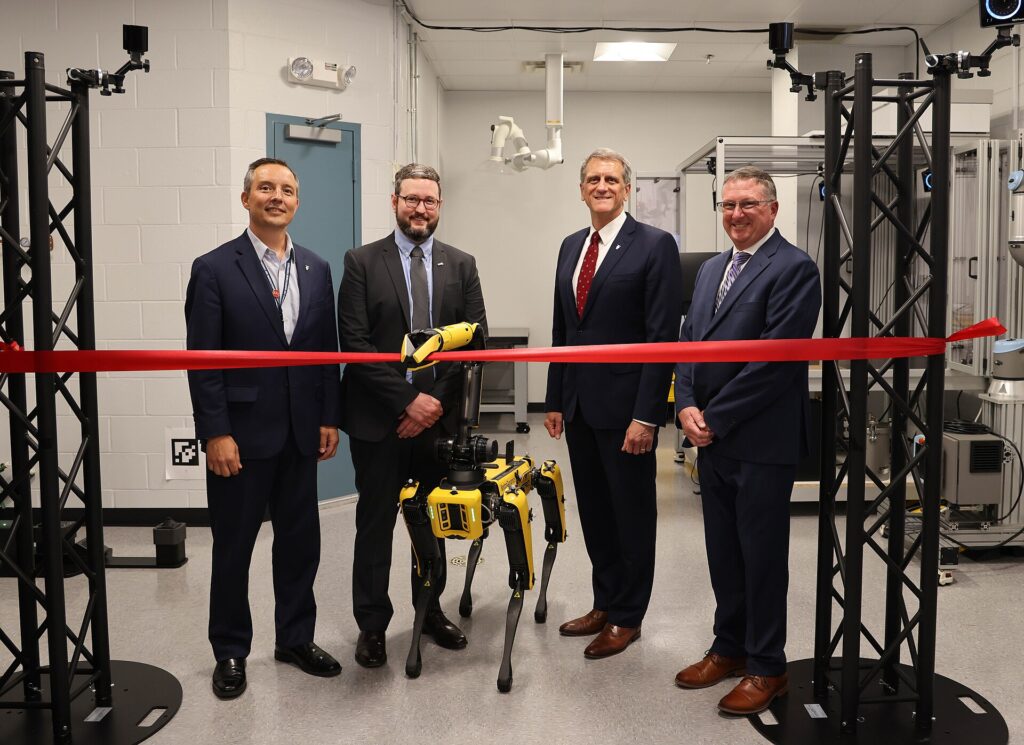
Featured image: From left: Darrell Phillipson, director, Air Force Research Laboratory, or AFRL, Materials and Manufacturing Directorate; Dr. Sean Donegan, Digital Manufacturing Research Team lead; Timothy Sakulich, AFRL executive director; and Dr. Charles Ormsby, Manufacturing, Industrial Technologies and Energy division chief observe as Boston Dynamics robot Astro cuts a ceremonial ribbon, officially opening the new Collaborative Automation for Manufacturing Systems Laboratory at Wright-Patterson Air Force Base, July 23, 2024. (U.S. Air Force photo / Sarah Perez) by U.S. Air Force AFRL by Erica J Harrah, Public domain, via Wikimedia Commons. Image source