Science has long been governed by a fundamental tension: the speed of idea generation versus the slowness of physical experimentation. In recent years, artificial intelligence has dramatically accelerated the thinking layer of scientific research—writing code, analyzing data, and designing experiments in real time. Yet, the actual execution of experiments—running tests, measuring outcomes, and validating results—has not kept pace. This asymmetry is driving a quiet but profound transformation in how research companies operate, one that is increasingly visible at the front lines of biotech and materials science.
What Happened: The Rise of Foundries and Navigators
At the heart of this shift are two distinct models of AI integration in scientific research: foundries and navigators. Foundries focus on reducing the cost of doing experiments by industrializing measurement processes. They use advanced technologies—such as next-generation sequencing, multiplexed assays, and automated lab equipment—to generate data at speeds orders of magnitude faster than traditional methods. Companies like Xaira, NewLimit, Octant, Tahoe, and Endura have built systems that allow hundreds of experiments to be run in parallel, with results generated in hours instead of weeks.
Navigators, by contrast, focus on reducing the cost of the thinking that comes before and after experiments. Rather than automating the physical act of running tests, navigators use AI to streamline decision-making, protocol design, data interpretation, and workflow management. These systems operate within a company’s existing infrastructure, improving how scientists plan, analyze, and communicate results. The gains are often invisible—no press releases, no headlines—but they are deeply impactful in day-to-day operations.
Key Facts and Examples
- AI has made software development faster, but scientific experiments remain bottlenecked by physical processes.
- Foundries use high-throughput technologies (e.g., microscopy, sequencing) to generate data at scale.
- Navigators use AI to automate triage, analysis, dashboard creation, and protocol iteration.
- Early-stage startups are adopting these models more rapidly due to fewer legacy systems and greater agility.
- At Endura Therapeutics, a biotech company, scientists now build interactive dashboards in hours instead of days, enabling real-time exploration of experimental data.
- Internal data portals built in-house allow scientists to see results immediately, eliminating the traditional queue for analysis.
These changes are not limited to large firms. Even small startups are seeing dramatic improvements. For instance, a team once evaluating 500 disease candidates could now narrow the field to a few dozen in a single week—thanks to AI-driven prioritization. The ability to rapidly iterate protocols and adapt analysis pipelines has made scientific experimentation more agile, echoing the software engineering principle of ‘move fast and break things’—but now applied to discovery rather than development.
How It Works: The Mechanics of Foundry and Navigator Systems
Foundries work by integrating physical automation with AI-driven data capture. For example, a lab might deploy robotic arms to run hundreds of chemical reactions simultaneously, with sensors recording temperature, pH, and reaction yield in real time. This data is then processed and made accessible through AI models that detect patterns and flag anomalies. The result is a massive increase in data volume and speed, which AI can then interpret.
Navigators, meanwhile, operate at the cognitive layer. They use language models to assist scientists in drafting experimental protocols, analyzing results, and generating visualizations. These models are not required to be large or proprietary—they only need to be capable of reasoning and adapting to context. For instance, when a scientist modifies an experiment protocol, the AI can generate updated code for data processing in minutes, rather than days. This eliminates the historical friction between the scientist who understands the experiment and the analyst who understands the code.
One of the most significant shifts is in data access. Previously, experimental results were stored in isolated, vendor-built systems that prioritized universal compatibility over scientific nuance. Now, in-house-built data portals reflect the unique characteristics of each experiment, allowing scientists to explore patterns that would have otherwise been invisible. This shift changes behavior—scientists begin to notice correlations and trends that were previously buried in slide decks or spreadsheets.
Why It Matters: The Broader Impact on Research
The rise of foundries and navigators marks a fundamental shift in how scientific discovery is conducted. By reducing the cost of both experimental execution and cognitive processing, these models enable faster iteration, broader exploration, and more inclusive decision-making. This is especially critical in early-stage startups, where time-to-market and resource constraints demand rapid adaptation.

Moreover, the democratization of data access means that scientists no longer need to rely on a single expert to interpret results. When data is presented in real time and in a format that matches the experiment’s context, it becomes a shared asset—enabling collaboration and reducing the risk of misinterpretation.
These changes also have implications for scientific culture. As AI becomes embedded in daily workflows, the role of the scientist evolves from one focused on execution to one focused on design, iteration, and judgment. The AI becomes a co-pilot—not a replacement—but one that enables deeper exploration of scientific questions.
Limitations and Open Questions
Despite its promise, the current model has notable limitations. One key issue is reproducibility. When AI-generated analysis is built on-demand—without version control or provenance tracking—it becomes difficult to verify or reproduce results. A figure generated by a language model may be accurate, but its code trail is often invisible, making it hard to audit or validate.
Another challenge is scalability. While early-stage startups can adopt these models with minimal overhead, larger organizations face hurdles related to compliance, governance, and legacy systems. These institutions often have complex software contracts, regulatory requirements, and organizational hierarchies that slow down innovation.
Finally, the effectiveness of navigators depends on the transparency of AI systems. If the AI’s reasoning is not inspectable—meaning no logs or traceability of tool calls or data sources—then the system cannot serve as a reliable lab notebook. As one contributor notes, ‘An agent that logs every tool call, every code version, every dataset hash speeds up interpretation and becomes the lab notebook the new workflow is missing.’
What to Watch Next
As AI continues to evolve in science, the next phase will likely focus on provenance and trust. The current model of on-demand analysis is powerful but fragile. Future systems will need to ensure that every AI-generated insight is traceable, versioned, and auditable—making the scientific process not just faster, but more reliable.
Additionally, the convergence of foundries and navigators may lead to hybrid models where AI not only runs experiments but also documents the entire thinking process. This could redefine how scientific knowledge is recorded and shared.
For those interested in the broader infrastructure of AI in science, the original source provides a detailed account of how these models are being implemented in real-world labs. For a deeper dive into AI’s role in scientific discovery, see Google’s AI in Science report. And for a broader view of AI’s trajectory, explore the future of latent space.
Sources & further reading
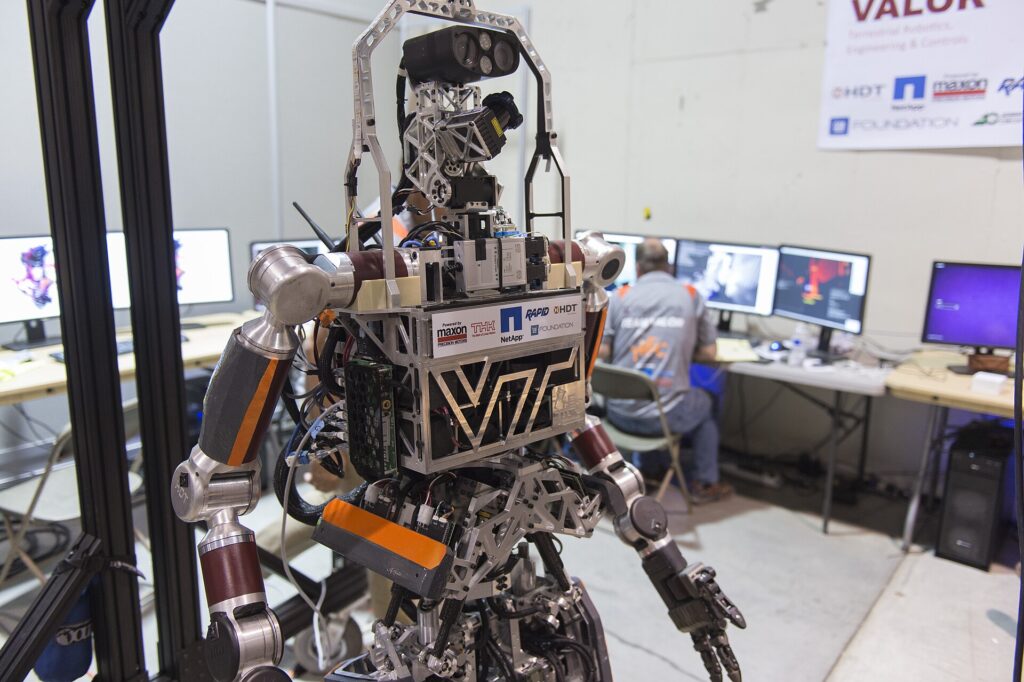
Featured image: ESCHER, short for Electric Series Compliant Humanoid for Emergency Response, is returned to the garage following the competition during the Defense Advanced Research Projects Agency Robotics Challenge (DRC) in Pomona, California. Designed, fabricated and assembled by engineering students at Virginia Tech, ESCHER leverages software and design learnings from another project underway at the lab, the ONR-sponsored Shipboard Autonomous Firefighting Robot, or SAFFIR. (U.S. Navy photo by John F. Williams/Released) by Office of Naval Research from Arlington, United States, CC BY 2.0, via Wikimedia Commons. Image source · License