
UK small and medium-sized businesses (SMBs) are spending more on software tools, even amid broader economic challenges. A recent report from Monzo Business reveals that over half of UK SMEs—56%—are confident about growth over the next year, and nearly two-thirds (62%) plan to expand their teams. This reflects a continued willingness among SMBs to invest in technology to support business development.
What Happened: A Shift in Spending and Operational Burden
Monzo Business’ Money Moves Report surveyed 1,000 UK SMBs and found that software spending has increased by 15% over the past year. This uptick suggests a growing belief that digital tools can help businesses operate more efficiently and scale. The report also highlights a significant operational cost: UK SMBs spend an average of 53 minutes each working day on financial admin tasks such as processing invoices, managing expenses, and reconciling accounts.
Of these, 49% of businesses say financial admin takes too long, and 39% believe it actively hinders growth. This time burden extends beyond daily operations—some businesses report missing opportunities to invest in new technology, equipment, premises, or hiring staff due to the time spent on administrative work.
Key Facts from the Research
- 56% of UK SMEs are confident about growth over the next year.
- 62% of SMBs plan to grow their teams in the coming year.
- Software spending has increased by 15% compared to the previous year.
- On average, UK SMBs spend 53 minutes per working day on financial admin.
- 46% of businesses cite rising costs as a top barrier to growth.
- 39% of businesses say financial admin actively blocks growth.
- 63% of SMBs say simpler financial admin would free up time for strategic activities like sales and customer engagement.
Of those who believe financial admin is a major obstacle, 21% say it prevents investment in technology, 20% in new markets, and 18% in hiring staff. These figures show a clear disconnect between investment in tools and the time required to manage them effectively.
Background: How Financial Admin Impacts Business Operations
Financial admin refers to the routine, repetitive tasks involved in managing a business’s finances—such as invoice processing, expense tracking, tax compliance, and financial reporting. These tasks are essential but often time-intensive, especially for businesses without dedicated finance staff or automated systems.
Before digital tools, many SMBs relied on manual processes, spreadsheets, or basic accounting software. While modern software has improved efficiency, many businesses still face challenges in integrating these tools into daily workflows. The time spent on admin is not just about task completion—it reflects inefficiencies in workflow design, data management, and system interoperability.
For example, a business may purchase a new project management tool or CRM to improve operations, but if it lacks automated invoice generation or expense tracking, the time spent on manual entry can negate the benefits of the investment. This illustrates a key insight: spending on software does not automatically translate into time savings or operational gains.
Why It Matters: The Gap Between Investment and Efficiency
While increased software spending signals optimism about digital transformation, the persistent time burden on financial admin reveals a deeper issue: the mismatch between tool adoption and operational efficiency.
Businesses that prioritize growth must not only invest in technology but also in how they manage their workflows. If financial admin consumes a significant portion of working time, it diverts energy from strategic activities such as customer acquisition, product development, and market expansion. This creates a risk that investments in software may fail to deliver the intended outcomes.

As Jordan Shwide, General Manager at Monzo Business, notes: ‘Small businesses are confident about the year ahead and thinking about how they can grow. However, running a business still comes with far too much financial admin, and our research shows that this isn’t simply an inconvenience—it can take time away from growth.’
For SMBs, this means that financial tools must be not just functional, but integrated and intuitive. The value of software lies not just in its features, but in how seamlessly it fits into existing operations and reduces administrative overhead.
Limitations and Open Questions
The Monzo Business report offers valuable insights, but it also raises important limitations. First, the data is based on self-reported responses, which may introduce bias. Second, the sample size—though large—does not represent all business types or regions, potentially skewing results. Third, the report does not assess the quality or usability of the software being used, only the amount spent.
Additionally, the study does not explore whether specific types of businesses—such as those in retail, hospitality, or creative fields—are disproportionately affected by admin burdens. Without such context, it’s difficult to determine which sectors face the greatest challenges.
Another open question is whether the time spent on admin is decreasing over time with new tools. While software spending has increased, the report does not track changes in administrative efficiency or the adoption of automation features such as AI-powered invoice processing or expense categorization.
What to Watch Next
Looking ahead, SMBs will need to focus not just on what tools they use, but how they use them. The next phase of digital transformation will likely involve deeper automation—tools that reduce manual input and integrate across systems.
Emerging solutions such as AI-powered financial assistants, automated expense categorization, and no-code accounting platforms may help bridge the gap between software investment and time efficiency. For instance, Jango demonstrates how AI agents can manage multi-user app workflows, while GoodSocials shows how AI can support content strategy with human oversight.
As businesses continue to invest in software, they must also evaluate how these tools support—not just replace—human roles. The future of SMB efficiency will depend on tools that are not only powerful, but also intuitive and integrated into daily operations.
For more on how AI and automation are reshaping business operations, see DevFest 2026: How Developers Are Building, Securing, and Scaling in the Agentic AI Era.
Sources & further reading
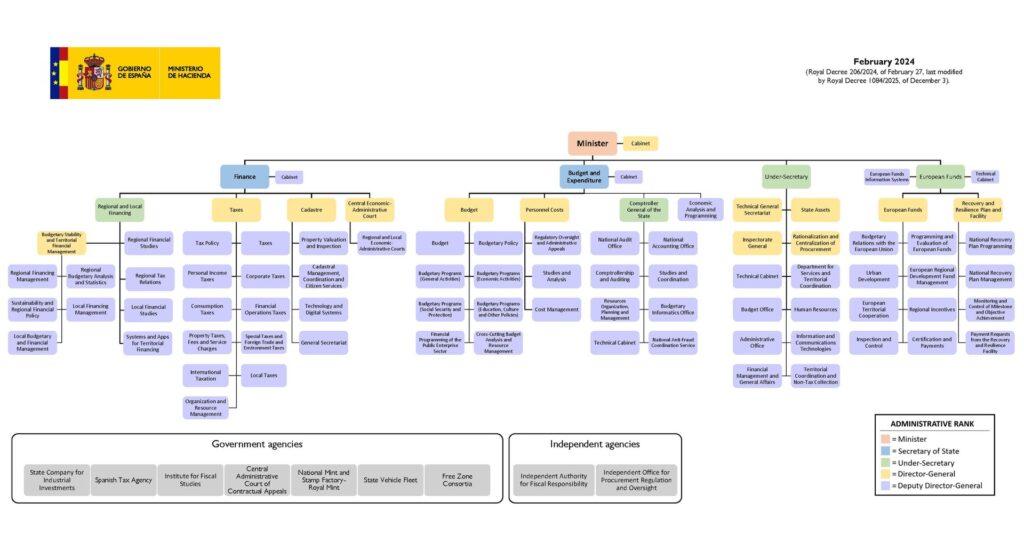
Featured image: Organizational chart of the Ministry of Finance in accordance with Royal Decree 206/2024, of February 27. by TheRichic, CC BY-SA 4.0, via Wikimedia Commons. Image source · License