
The European Space Agency’s Jupiter Icy Moons Explorer (Juice) will perform a third Earth flyby on 28 September 2026, using a gravity assist to fine-tune its trajectory toward Jupiter. This maneuver, guided by Earth’s gravitational field, is a critical step in Juice’s long journey to the outer Solar System.
What Happened: A Precision Flyby
On 28 September 2026, Juice will pass within 8,640 kilometers of Earth’s surface, traveling over the Indian Ocean at 13:45 CEST (11:45 UTC). The spacecraft will come within view of Australia between 15 and 30 minutes before closest approach, moving from the northeast to the northwest of the continent. This flyby will alter Juice’s orbital path by approximately 20 degrees and increase its velocity by about 3.5 kilometers per second.
Flight controllers at ESA will execute a navigation campaign beginning on 17 August 2026, with six pre-flyby correction slots—spanning four weeks, two weeks, one week, and three days before the event—to ensure the spacecraft arrives at the correct angle and speed. The final correction, scheduled for 08:00 CEST on 28 September, will serve as a contingency to address navigation errors or avoid collisions with other satellites. According to ESA, this maneuver will not be required if all calculations are accurate.
Key Facts About the Flyby
- Closest approach: 28 September 2026 at 13:45 CEST (11:45 UTC)
- Distance from Earth: 8,640 km
- Velocity increase: ~3.5 km/s
- Directional change: ~20 degrees
- Earth shadow period: 21:24 to 06:03 CEST on 27–28 September 2026
- Science instruments active during flyby: All 10 instruments will operate to collect data on Earth and the Moon
How Gravity Assists Work: The Physics Behind the Maneuver
Gravity assists are a cornerstone of deep-space navigation. Instead of using fuel to change a spacecraft’s velocity, mission planners use the gravitational pull of planets to alter a spacecraft’s speed and direction. This technique leverages the conservation of momentum and energy in orbital mechanics.
For Juice, the journey began in April 2023 with a launch from Europe’s Spaceport in Kourou. It first performed a lunar-Earth flyby in 2024, a braking maneuver that redirected its path toward Venus. A subsequent Venus flyby in 2025 provided a velocity boost. The 2026 Earth flyby will complete the sequence of gravitational slingshots, setting Juice on a trajectory that will allow it to reach Jupiter in July 2031.
Each flyby is carefully calculated to ensure the spacecraft gains the right amount of speed and direction. Without these maneuvers, Juice would require an impractical amount of fuel to reach Jupiter and maintain a stable orbit around it. The mission’s success relies on precise timing and orbital dynamics, with flight controllers using real-time data to adjust course.
Why This Matters: Science and Mission Efficiency
Gravity assists are not just a technical necessity—they are a fundamental principle in space exploration. By using the gravitational fields of planets, spacecraft can travel vast distances without consuming large amounts of fuel, which is critical given the limited capacity of current propulsion systems.
For Juice, this strategy ensures that it will arrive at Jupiter with sufficient fuel to enter orbit and conduct detailed studies of its icy moons—Ganymede, Callisto, and Europa. These moons are believed to harbor subsurface oceans, making them prime candidates for the search for extraterrestrial life. The mission will also study Jupiter’s magnetic field, radiation belts, and plasma environment, offering insights into gas giant systems beyond our own.

Additionally, during the flyby, Juice will spend several days in Earth’s magnetotail—the region of charged particles stretched behind Earth by the solar wind. This provides a rare opportunity to collect magnetic field data that can be combined with observations from the European–Chinese Smile mission, enhancing our understanding of planetary magnetospheres.
The spacecraft’s navigation camera will also capture images of the Moon’s horizon, testing a new optical navigation technique. These images will help refine the accuracy of future trajectory corrections during the mission. All flyby data, including images, will be shared via ESA’s social media and website, with the final images released on 29 September.
Limitations and Open Questions
While gravity assists are efficient, they are not without risk. The flyby occurs during Earth’s shadow, meaning Juice will operate solely on battery power for over 10 hours. This increases the risk of power depletion, especially if instrument operations are not prioritized. To mitigate this, the team has focused on essential science observations, ensuring critical instruments remain active.
Another limitation is the limited visibility for amateur astronomers. While Juice may be visible through binoculars or telescopes, its brightness and trajectory are not ideal for widespread public observation. The flyby also occurs during a time of high solar activity, which may affect the performance of sensitive instruments.
Moreover, the mission’s long timeline—spanning eight years of travel and multiple flybys—raises questions about long-term reliability and the potential for mechanical degradation over time. While Juice has already completed two successful flybys, the success of the third will be a key indicator of the mission’s overall robustness.
What to Watch Next
Following this flyby, Juice will continue its journey toward Jupiter, with a planned arrival in July 2031. It will then enter orbit around Jupiter and conduct 35 flybys of its icy moons before transitioning to a dedicated orbit around Ganymede in 2034.
Space enthusiasts and scientists alike will be watching closely for updates on Juice’s progress. The mission’s success will depend on the precision of its navigation, the health of its instruments, and the stability of its trajectory. For those interested in planetary science and deep-space missions, Juice offers a rare opportunity to observe a spacecraft in motion across the Solar System.
For a deeper look at how spacecraft navigate the outer Solar System, see the original ESA source. For a broader context on planetary missions, explore BepiColombo’s arrival at Mercury. For insights into how instruments are calibrated in space, refer to instrument calibration in space-based research.
Sources & further reading
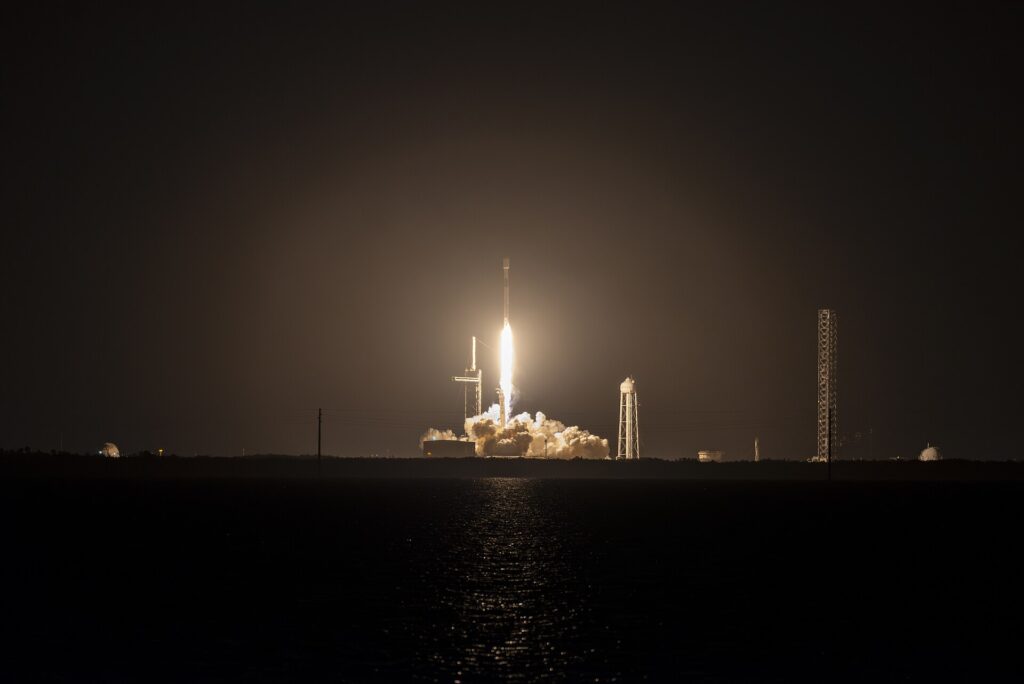
Featured image: A Falcon 9 rocket carrying the Blue Ghost lander launches from Launch Complex-39A at Kennedy Space Center, Florida, Jan. 15, 2025. Once deployed the Blue Ghost lander will begin its 45-day journey to the moon, where it will land for NASA to perform numerous science and technology demonstrations, including lunar subsurface drilling, sample collection, and X-ray imaging of Earth’s magnetic field. (U.S. Space Force photo by Deanna Murano) by U.S. Space Force photo by DeAnna Murano, Public domain, via Wikimedia Commons. Image source