Artificial intelligence has become a staple in modern workplaces, promising faster decision-making and greater productivity. However, a growing body of research suggests that the ease with which AI tools are accessible may come at a hidden cost: a decline in critical thinking and innovation.
What Happened: The Productivity Trap
According to a 2015 study of computational biologists, when researchers could easily view each other’s half-finished work, they spent more time refining existing solutions than exploring new approaches. The range of ideas explored shrank significantly. This pattern is not limited to scientific fields. In organizational settings, when AI tools offer instant, ‘good enough’ answers with minimal effort, employees and teams begin to default to reusing known solutions rather than experimenting with novel approaches.
As a result, organizations may see a short-term boost in output—tasks completed faster, workflows streamlined—but over time, the capacity for original thinking diminishes. This phenomenon is known as the ‘productivity trap’: faster execution in the short term, but a gradual erosion of problem-solving skills and creative capacity.
Key Facts and Evidence
- When instant, low-effort AI solutions are available, individuals are more likely to reuse existing answers than develop new ones.
- Teams begin to settle on a small set of familiar approaches, reducing diversity in problem-solving methods.
- Internal sharing sessions for AI tools—once vibrant with new ideas—have been observed to produce fewer genuinely novel concepts over time.
- Research from Imperial College London shows that when solutions are easy to access, people are less likely to engage in deep cognitive work or explore alternative paths.
This behavior is not driven by laziness or lack of skill, but by a psychological shift: the absence of cognitive pressure. When a solution is instantly available, there is no need to think through alternatives or assess trade-offs. This reduces the mental effort required to solve problems, which in turn weakens the development of expertise and adaptability.
Background: How AI Tools Work in the Workplace
Modern AI tools—such as chatbots, content generators, and automated report writers—allow users to generate responses or outputs with minimal input. These tools often require little training, no coding, and operate through simple prompts. For example, a manager might ask, ‘Summarize this quarterly report,’ and receive a polished output in seconds.
While this efficiency is valuable, it changes the nature of work. Instead of engaging in the iterative process of analysis, evaluation, and refinement, users bypass these steps. The AI performs the cognitive labor, and the human simply accepts the output. Over time, this routine becomes habitual, and the mental discipline required to think critically about problems erodes.
Organizations that adopt AI without intentional design may inadvertently structure work environments where innovation is not incentivized. The culture shifts from one of inquiry and experimentation to one of efficiency and replication.
Why It Matters for Business Leaders
Businesses rely on innovation to remain competitive. Whether it’s developing new products, adapting to market changes, or solving complex operational challenges, original thinking is essential. If AI tools reduce the need for human problem-solving, the organization risks becoming stagnant.
Consider this: a company that uses AI to generate marketing copy may produce high-quality content quickly. But if every team member relies on the same prompt and output, the diversity of messaging and creative responses diminishes. This lack of variation can lead to poor customer engagement and reduced adaptability in dynamic markets.

Moreover, innovation often emerges from the ‘fringe’ of experimentation—unstructured, untested, and uncertain. When AI makes these experiments easier to skip, the foundation for breakthrough ideas is weakened.
Limitations and Open Questions
The current evidence is observational and based on specific case studies. It does not establish a direct causal link between AI accessibility and innovation loss across all industries or organizational types.
Additionally, the impact may vary depending on context. For example, in roles where creativity is central—such as design or strategy—AI use may have a more pronounced effect on cognitive development than in routine, data-driven tasks.
There are also no established guidelines for how to balance AI efficiency with cognitive engagement. Questions remain about how to design AI tools that support, rather than replace, human judgment and innovation.
What to Watch Next
As AI tools become more integrated into daily workflows, organizations will need to evaluate not just performance metrics, but also the long-term impact on cognitive development and innovation. Future research should explore how AI can be designed to encourage exploration, not just delivery.
One promising direction is the development of AI systems that prompt users to consider alternatives, evaluate risks, or reflect on their decisions—tools that maintain a human-in-the-loop mindset. For instance, GoodSocials uses AI to generate content but includes human approval steps to preserve creative oversight. Similarly, Jango enables multi-user testing with AI agents, encouraging collaborative problem-solving rather than passive output.
As AI evolves, businesses must ask not just whether it can do a task faster—but whether it helps people think better. The future of workplace AI may not be about speed alone, but about cultivating deeper cognitive engagement.
For a deeper dive into how developers are shaping the future of AI systems, see DevFest 2026: How Developers Are Building, Securing, and Scaling in the Agentic AI Era.
Sources & further reading
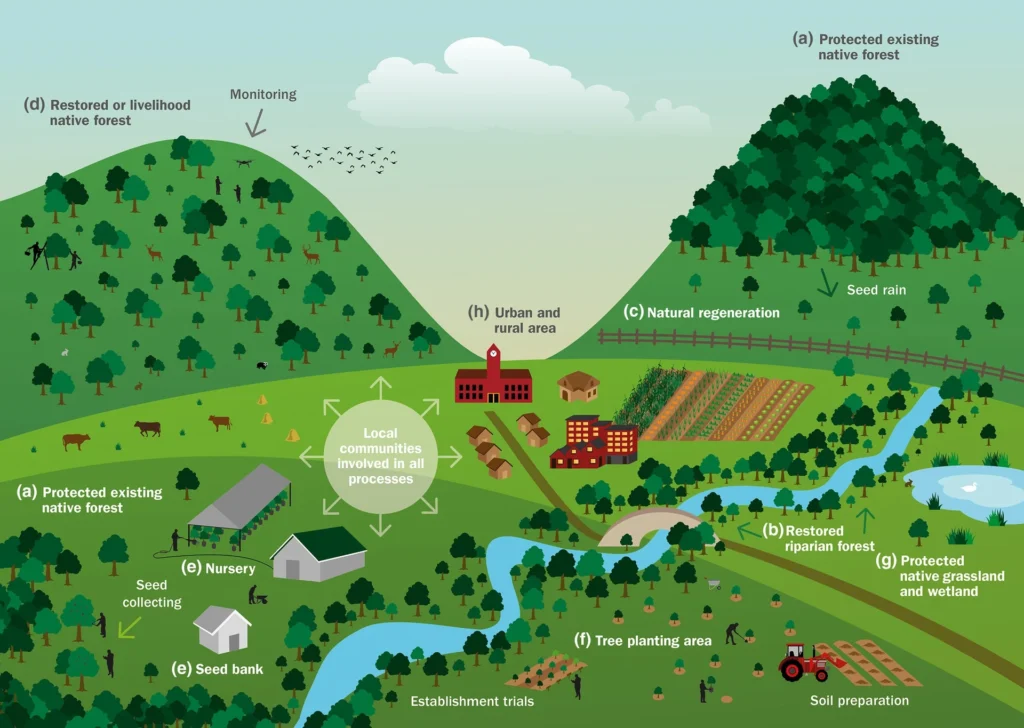
Featured image: Schematic view of a successful reforestation programme. This landscape contains several components: (a) protected existing native forests, either old- or second-growth, where native seeds are collected; (b) restored riparian forest creating a biological corridor connecting remaining forest patches; (c) a naturally regenerating area, adjacent to an existing native forest that provides seed rain for natural regeneration; (d) restored or livelihood native forest, which might include non-invasive exotic useful species for timber and non-timber forest products (NTFPs), where people monitor biomass and biodiversity recovery; (e) tree nursery and seed bank where native seeds are stored and propagated; (f) tree planting area, with a section dedicated to establishment trials; (g) protected native non-forest ecosystems, such as grassland and wetland; (h) urban and rural areas, with sustainable agriculture and livestock. by Di Sacco, A., Hardwick, K.A., Blakesley, D., Brancalion, P.H.S., Breman, E., Cecilio Rebola, L., Chomba, S., Dixon, K., Elliott, S., Ruyonga, G., Shaw, K., Smith, P., Smith, R.J. and Antonelli, A. (2021), CC BY 4.0, via Wikimedia Commons. Image source · License