MakerMap is a new platform launched in 2026 that presents a living, interactive map of independent creators—commonly referred to as ‘makers’—who are building products, tools, and ideas across the globe. The platform aggregates over 4,000 profiles, each detailing what individuals are creating, where they are located, and how they engage with their communities.
What Happened: A Simple Idea, Real-World Impact
Founded by Martijn Verbove, MakerMap began as a personal project rooted in a simple observation: the people shaping the future—those building startups, tools, and side projects—are scattered across the world, yet there is no centralized way to see them in action. Verbove launched the platform to address this gap, aiming to create a visible, evolving map of innovation in motion.
Since its debut, MakerMap has attracted over 160 followers on Product Hunt and has seen active engagement from users who have added their profiles and shared feedback. The platform is not just a directory—it is a social ecosystem where users can search for specific combinations of interests, locations, and project types. For example, users can explore ‘AI founders in Lisbon’ or ‘designers building iOS apps’ with precision and intent.
Key Facts About MakerMap
- MakerMap launched in 2026 and is currently accessible at makermap.lol.
- It features over 4,000 active maker profiles, each with dynamic content including posts, activity, growth metrics, and project updates.
- Users can search by niche, location, interest, or project type—such as ‘gym bros in Lisbon’ or ‘Twitter tools’—to find relevant creators.
- Profiles are tied to users’ social media accounts, primarily X (formerly Twitter), which serves as the primary authentication method.
- Access to the platform is free, though users can choose to support it financially by paying a small fee or purchasing a ‘Ship’ or ‘Yacht’ for increased visibility.
The platform’s core innovation lies in its emphasis on real-time activity. Unlike traditional maker directories that become stale after initial profile creation, MakerMap is designed to reflect ongoing engagement. Profiles are updated through user activity on X, and the platform dynamically tracks posts, comments, and project progress.
How It Works: A Living, Evolving Map
MakerMap functions as a hybrid of a social network and a geographic map. Users are invited to add their profiles by visiting makermap.lol/introduce or by messaging the @MakerMapBot on X. Each profile includes a location pin, a brief bio, a list of projects, and links to social media activity.
Profiles are not static. The platform relies on continuous interaction—users post updates, respond to comments, and share new developments. This ensures that the map remains current and reflects the actual trajectory of a maker’s work. As one user noted, ‘Every maker directory I’ve seen goes stale because people fill out a profile once and never touch it again.’ MakerMap counters this by design, with the platform encouraging ongoing participation.
Authentication is required via an X account. However, users do not need to be active on X to use the platform—only to have an account. This lowers the barrier to entry while maintaining a connection to a widely used social ecosystem.
Why It Matters: Connecting the Maker Ecosystem
MakerMap addresses a critical gap in the innovation ecosystem: the invisibility of independent creators. Most innovation happens outside formal networks, in small-scale, personal projects. These individuals often lack visibility, funding, or opportunities to connect with peers.
By making maker activity visible and searchable, MakerMap enables discovery and real-world interaction. Early user feedback indicates that people are already using the platform to arrange in-person meetings—something the founder explicitly hoped for. This suggests that MakerMap is not just a digital directory, but a catalyst for community building.
For those working on side projects, startups, or personal inventions, MakerMap offers a way to find collaborators, share ideas, and validate interest in a project. It also provides a sense of belonging to a global community of creators.
Moreover, the platform reflects a broader trend in technology: the move from centralized platforms to decentralized, user-driven networks. MakerMap exemplifies how innovation can emerge from grassroots efforts, supported by simple, elegant design and strong community engagement.
Limitations and Open Questions
Despite its promise, MakerMap faces several limitations. First, its reliance on X as a login mechanism may exclude users who do not use or have accounts on that platform, limiting accessibility.
Second, while the platform tracks activity, it does not yet offer tools for project collaboration, project management, or shared development. It functions as a discovery tool, not a workflow platform.
Third, the quality and depth of profiles vary. Without editorial curation or verification, some entries may lack accuracy or depth, potentially leading to misinformation or misattribution.
Finally, the platform’s growth is still in early stages. With only 4,000+ profiles, it is not yet representative of the global maker ecosystem. Long-term scalability and data quality remain open questions.
What to Watch Next
As MakerMap evolves, several developments will be critical to observe. First, whether the platform expands beyond X to support other social media accounts or identity systems. Second, how it handles user privacy and data sharing, especially given the sensitivity of personal and project information.
Third, whether MakerMap introduces features such as project matching, collaboration tools, or community challenges to deepen user engagement. Finally, its ability to scale beyond a niche audience and become a recognized resource for innovation tracking.
For those interested in the future of independent innovation, MakerMap offers a tangible example of how decentralized, user-driven platforms can help connect people who are building the future—without needing institutional backing.
For deeper insights into how AI tools are being used in real-world innovation, see SWE-Serve’s analysis of AI deployment gaps. For a look at how AI reasoning is applied in medical imaging, explore NV-Reason-CT. And for a broader understanding of how AI tools are shaping side projects, see Token Forecaster.
Sources & further reading
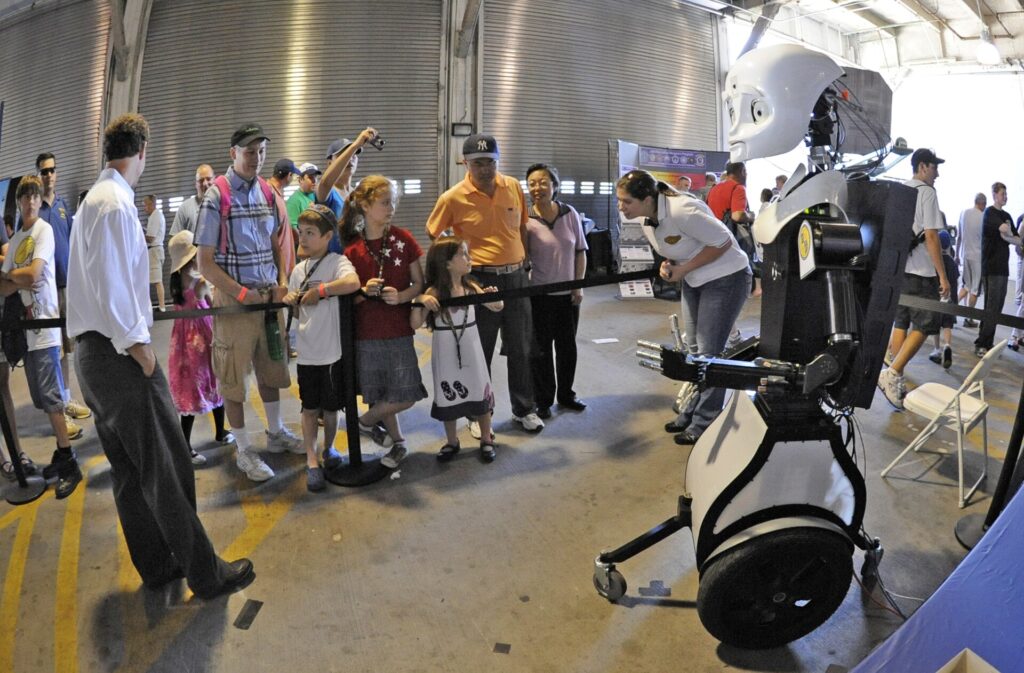
Featured image: NEW YORK (May 31, 2010) Lauren Gates, right, from the Office of Naval Research, and Greg Trafton, left, cognitive scientist with the Naval Research Laboratory, answer visitors questions about Octavia during Fleet Week New York 2010. The ONR human robotics interaction research program at the Naval Research Laboratory focuses on the abilities of teams of humans and autonomous systems to communicate clearly, collaborate to solve problems, and interact via modality both locally and remotely. (U.S. Navy photo by John F. Williams/Released) by U.S. Navy photo by John F. Williams, Public domain, via Wikimedia Commons. Image source